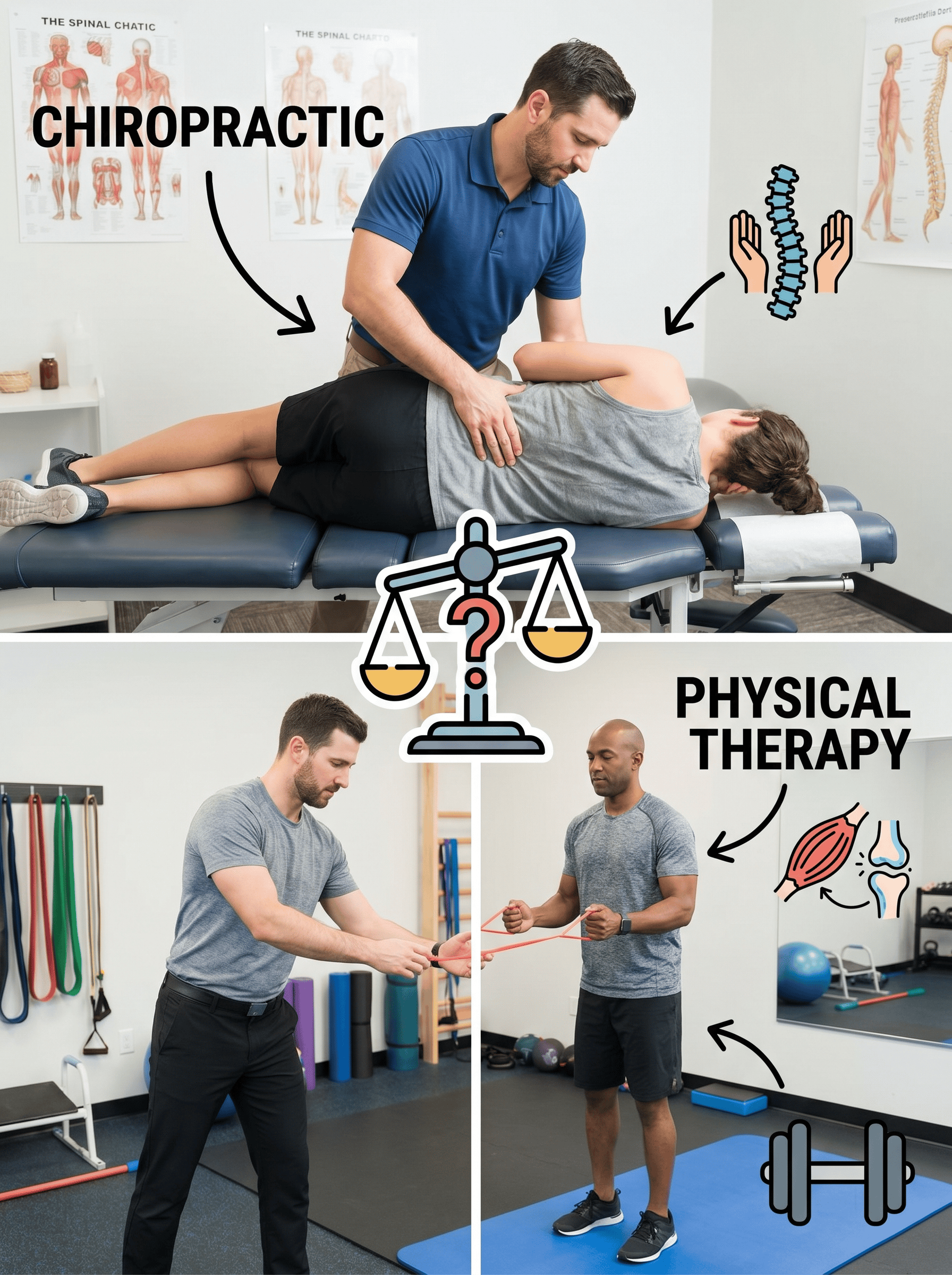

Your doctor says go to physical therapy. Your coworker swears by her chiropractor. Your neighbor says they’re basically the same thing.
And now you’re stuck in the middle, scrolling comparison articles at 11 PM, more confused than when you started.
Sound familiar? You’re not alone. “Should I see a chiropractor or a physical therapist?” is one of the most common questions we hear at McAlpine Chiropractic — and the honest answer is that it depends on what’s going on with your body right now.
We’re not here to tell you one is better than the other. We’re here to help you figure out which one — or which combination — actually makes sense for you.
TL;DR — The Short Version
If you’re scanning, here’s the spoiler:
- Chiropractors and physical therapists treat overlapping problems with different primary tools. Chiropractors are best at restoring joint mobility and addressing spinal/joint fixations. PTs are best at rehab, strengthening, sport-specific retraining, post-surgical recovery, and movement re-education.
- The right answer often isn’t one or the other — it’s really both, in the right order. A good chiropractor will refer you to a PT when you need rehab. A good PT will refer you to a chiropractor when joint mobility is limiting your progress.
- Pick the provider who looks out for your interests. That means someone who has expertise in their lane, knows when you need the other lane, and refers without ego. We try to be that office, and we try to work with PTs who do the same. In fact, we regularly try to coordinate care with Holland Physical Therapists and two of our favorites are Rehab 4 Performance and Ruther Health + Wellness.
The rest of this article will walk you through how to tell which one you need first, what each profession actually does, and what to do if you’ve already tried one and gotten stuck.
They’re Not the Same Thing (Even Though They Treat Similar Problems)
Here’s where the confusion starts: both chiropractors and physical therapists treat back pain, neck pain, and joint problems. But they approach the problem from different angles.
While chiropractors can be trained to offer rehab exercises, dry needling, and mobility work (the traditional domain of physical therapists), and physical therapists can be trained to manipulate joints (the traditional domain of the chiropractor), it’s rare to find a single professional whose experience and equipment cover everything well. There’s significant overlap between the two professions — and it deserves a more honest conversation than most comparison articles offer.
This isn’t to say PTs can’t address structure, or that chiropractors can’t do good manual therapy. Both are true. What’s also true is that overreach exists in both directions, and the best results usually come from a provider who knows their lane.
Two practical filters help here:
- As a patient, would you rather have your low back or neck adjusted by the professional who does it 5,000 times a year, or by the one who does it occasionally between other techniques?
- And conversely, would you want your rehab program designed by the provider with the equipment, the space, and the daily reps of progressive exercise prescription — or by someone who offers “three stretches” on the way out the door?
Our take, plainly: we are chiropractors. We do our job well. If we see that you need more than three structured exercises or stretches, you need to see a physical therapist — and we want to refer you to one. We try to work with PTs who feel the same way about referring back when joint mobility is the limiting factor.
What Chiropractors Actually Do
Chiropractic care focuses on spinal alignment and joint mobility — and the downstream impact those have on the rest of the body, particularly the nervous system. When vertebrae shift outside their normal position they can become stuck or fixated, restrict movement, generate protective muscle tension, compress nerves where they exit the spine, and create pain patterns that radiate to places the patient never connects back to the spine itself.
In our office, the chiropractor uses hands-on manual adjustments, gentle instrument-based adjustments where they fit the case better, non-surgical spinal decompression, Class IV laser therapy, and other manual techniques to restore alignment, free fixated joints, and take pressure off nerves. The goal is mechanical: get the joint moving correctly again so the surrounding system — muscles, nerves, fascia — can stop guarding and start functioning normally.
That’s the lane we’re in. We do it a lot, and it’s what we’re set up for.
What Physical Therapists Actually Do
As Eric Hamilton, DPT at Rehab 4 Performance describes it:
For individuals, physical therapy focuses on identifying and addressing the underlying causes of pain, injury, and movement limitations. Through a combination of objective data assessment, hands-on treatment, targeted exercise, and performance-based rehabilitation, physical therapists help patients restore strength, mobility, stability, and confidence in movement. Whether recovering from an injury, managing recurring aches and pains, or looking to improve performance, physical therapy aims to help people move better so they can continue doing the activities they enjoy.
While chiropractic care often focuses on improving joint mobility and reducing pain through spinal and extremity adjustments, physical therapy places a greater emphasis on long-term movement quality, strength development, and injury mitigation. Rather than being competing services, the two professions can work very well together. Chiropractic care may help restore mobility and provide symptom relief, while physical therapy helps reinforce those improvements through corrective exercise, strength training, and movement retraining. For many adults and active individuals, combining both approaches can create a comprehensive plan that addresses pain, improves function, and supports long-term performance.
Where chiropractic care is structural and joint-focused, physical therapy is functional and movement-focused. Both are evidence-based. Both have clear cases where they’re the right first call.
Two Real-World Examples
The clearest way to see how this works is with cases where both professions belong in the room.
Scoliosis. In an ideal world a scoliosis patient has both providers — the chiropractor working on segmental joint mobility and the related neuromuscular consequences, and the physical therapist running a structured Schroth-style or scoliosis-specific exercise program to build the asymmetric strength needed to manage the curve long-term. Neither alone gets the patient as far as the two together.
Ankle sprain. A patient rolls an ankle. Several of the small joints in the ankle and midfoot become fixated as the body splints to protect the injury. The chiropractor (or sports chiropractor) mobilizes those fixated joints to restore proper movement. The PT then takes the rehabilitation from there — proprioception drills, strength progressions, return-to-sport conditioning. Skip step one, and the exercises are working around a movement restriction that’s going to take an eternity to fully release on its own. Skip step two, and the joint is mobile but the surrounding system isn’t strong enough to keep the ankle from rolling next time.
In our eyes, that pattern actually repeats across many conditions: free the joint, then train the system around it.
The Real Question Isn’t “Which One” — It’s “Who Coordinates”
This is what most comparison articles miss entirely.
The best provider for your case — chiropractor or PT — is the one who knows their job, knows the boundary of their job, and refers you when you need someone else.
Two common sequences in our experience:
- Chiro-first → PT. The chiropractor addresses the joint restriction and pain pattern with manipulation, decompression, and the relevant manual therapies. Once mobility is back and pain is controlled, the patient is referred to a PT to build strength and movement patterns that will keep the result holding long-term.
- PT-first → chiro. The PT begins with stretching, soft-tissue work, and exercise-based retraining. If the PT identifies a joint range-of-motion limitation that exercises and stretches aren’t releasing, the patient is referred to a chiropractor to address the fixation. Then the rehab program continues with the joint actually moving correctly.
Neither sequence is “better.” The right starting point depends on what’s actually limiting your progress — and the right provider will be honest about which one you are.
Why a Stuck Joint Often Needs Manual Adjustment, Not Just Exercise
This is the part we want to be careful about, because it’s where most “chiro vs PT” articles either oversell chiropractic or undersell it. Here’s the honest mechanical picture.
When a vertebra has become stuck outside its normal alignment and is compressing a nerve or generating a pain pattern, exercises and mobility drills aimed at the surrounding muscles don’t necessarily address the structural shift or the range-of-motion aberration occurring within the joint itself.
Anyone who’s had a manual spinal adjustment performed on a fixated segment knows the distinct feeling: a sense of blocked motion that releases with a discrete “pop” (a cavitation of gas within the joint capsule) when the joint mobilizes. Anyone who’s experienced that done professionally at a stuck vertebra can appreciate the precise, short-duration force required — and that exercises and stretches usually can’t reproduce that force in a controlled, joint-specific way. They certainly can’t do it safely targeted to one specific fixated segment.
That’s the case for sequencing structure-first when the structural piece is what’s actually stuck. As we said earlier — when alignment is the root issue, structure-first care often gets the exercises to stick. Sometimes that means chiropractic alongside PT, sometimes one before the other. The right sequence depends on what’s actually limiting your progress.
What If You’ve Already Tried One and It Didn’t Work?
If you’ve been doing PT and your progress has stalled, that’s worth a second look. Sometimes a structural piece — misalignment, nerve compression, disc involvement — needs to be addressed in parallel for the exercises to take hold. We’ll happily coordinate with your PT to figure that out.
The reverse is true too. If you’ve been getting adjusted and you keep falling back into the same pain pattern, the missing piece is probably progressive strengthening and movement retraining — and a PT is who you want for that. We’ll make the referral, and we won’t be bothered that the next phase needs a different provider.
When Chiropractic Isn’t the Right Call
Let’s be straight — we don’t want to oversell ourselves.
Chiropractic care isn’t appropriate for every situation or case. If you have a fracture, severe spinal instability, certain infections, an acute disc herniation with progressive neurological deficit, a post-surgical condition, or a condition that requires surgery, a chiropractor shouldn’t be your first stop. We screen for these, and we’ll refer you to the right specialist — orthopedic surgeon, neurologist, primary care physician, PT, or otherwise — when that’s what the situation needs.
Honesty about scope should be part of how we all practice in healthcare. You deserve a provider who tells you the truth, even when the truth is “you need someone else first.”
The takeaway: both work. Both are reasonable first-line conservative care for low back pain. Cost, access, communication, and the specific clinical picture should drive the choice — not a turf war between the professions.
PTs We Trust to Refer Our Patients To
Rehab 4 Performance — Dr. Eric Hamilton, DPT
- Specialization: Sports and orthopedic medicine (dry needling, orthopedic injuries and post-op, athletic injuries and performance training)
- Locations:
- Holland — 117 Coolidge Ave, Holland (inside CrossFit Lake Effect)
- Hudsonville — 3229 Oak Street, Hudsonville (inside ARMR Total Fitness)
- Jenison — 1709 Dewent Dr, Jenison (inside Sweat Social)
- Phone: 248-914-1664
- Email: info@rehabforperformance.com
Ruther Health + Wellness — Dr. Kelly Ruther
- Specialization: Pelvic floor, dry needling, post-partum rehab, pregnancy
- Location: 454 Baypark Drive, Suite 10, Holland, MI 49424
- Phone: 616-537-6613
- Email: kelly@rutherhealth.com
If a PT we know and work with isn’t the right fit for your situation, we’d like the chance to help you find one who is. Coordinated care beats siloed care for almost every musculoskeletal complaint we see.
Frequently Asked Questions
Should I see a chiropractor or a physical therapist for my back pain?
It depends on what’s driving the pain. If your symptoms are tied to spinal misalignment, joint fixation, nerve compression, or disc involvement, chiropractic care is often the best starting point. If the limiting factor is muscle weakness, post-surgical recovery, balance, or movement dysfunction, physical therapy may be the better first step. Many patients benefit from both — and the best care plan tells you which to start with and when to switch.
What’s the actual difference between a chiropractor and a physical therapist?
Chiropractors focus on joint mobility and spinal alignment through hands-on manual adjustments, instrument-assisted techniques, and related manual therapies. Physical therapists focus on rehabilitation, strengthening, and movement retraining through exercise programs and hands-on soft-tissue work. There’s overlap, but each profession has a different center of gravity.
Will I need to keep going to a chiropractor forever?
No. Most patients complete a corrective care plan, then transition to occasional maintenance visits — similar to how you might see a dentist for cleanings after your teeth are healthy. Ongoing care is always optional, never required.
Is chiropractic care safe?
Yes. Systematic reviews of spinal manipulation find that serious adverse events are rare, and the side effects that do occur are usually musculoskeletal, transient, and mild to moderate. The most common is mild soreness lasting 24–48 hours — similar to what you’d feel after a new workout. We always perform a thorough evaluation before any treatment, and we screen for contraindications.
Can I do both chiropractic and physical therapy at the same time?
Absolutely — and many patients get better results when the two are coordinated. We’re happy to communicate with your PT to make sure both treatments complement each other rather than duplicating effort.
Which one gives faster results?
Chiropractic adjustments often produce a noticeable change in mobility and pain within the first few visits when joint fixation is the issue. Physical therapy typically produces gradual, durable improvement over weeks of consistent exercise. If immediate mobility and pain relief is the priority, chiropractic care tends to deliver faster initial change; PT builds the long-term resilience that keeps the result holding.
Does insurance cover both? Do I need a referral?
Most insurance plans cover both chiropractic and physical therapy, though coverage varies. In Michigan, you can self-refer to a chiropractor — no physician referral needed. PT may require a referral depending on your plan. Call us at 616-392-7031 and we’ll verify your chiropractic coverage before your first visit.
My doctor told me to try PT first — should I see a chiropractor instead?
Your doctor’s advice matters, and we’d never tell you to ignore it. PT first is often a reasonable starting point. What’s also true is that you can see a chiropractor in Michigan without a physician referral, and if PT alone hasn’t gotten you where you need to be, adding chiropractic care to the plan is an option many physicians support.
Ready to Figure Out What Your Body Actually Needs?
If you’re going back and forth trying to decide, the simplest thing you can do is come in and talk to us. We’ll do a full evaluation, tell you honestly what we think is going on, and help you put together a plan — whether that’s chiropractic care, a referral to physical therapy, or a coordinated combination of both.
Call McAlpine Chiropractic at 616-392-7031 or book online through Jane App to schedule your visit. We’re located in Holland, MI, and we’re here to help you get out of pain.
Reference:
– Rubinstein SM, de Zoete A, van Middelkoop M, Assendelft WJJ, de Boer MR, van Tulder MW. Benefits and harms of spinal manipulative therapy for the treatment of chronic low back pain: systematic review and meta-analysis of randomised controlled trials. BMJ. 2019;364:l689. doi:10.1136/bmj.l689 — adverse events were generally musculoskeletal, transient, and mild to moderate; serious adverse events were rare and not increased versus placebo.