
You’ve tried the stretches. You’ve iced it. You’ve taken the ibuprofen. And the pain is still there — maybe a little better, maybe not. If that sounds like you, laser therapy might be the right next step. But not always. I want to walk you through what Class IV laser therapy actually does, the conditions we see it work well for in our clinic, the ones it doesn’t, and what to expect when you come in.
Our deep-dive on this treatment lives on our laser therapy service page — read that for the full picture, including how we combine it with adjustments and decompression. This post is the plain-English version.
What Class IV Laser Therapy Does — Two Things at Once
When the laser light hits your body, two things happen. Almost everything else the laser does comes back to one of these two mechanisms.
1. Photobiomodulation. This is the cellular effect. The light is absorbed by mitochondria — the energy generators inside every cell — and ramps up their output. I like to think of it as turning up the metabolism in the injured area. If you have a sprain, a strained muscle, an irritated nerve, an inflamed tendon — the cells in that area need fuel to repair themselves. The laser gives them more of it. Another way to think about it: it’s like putting higher-octane fuel in your car. Same engine, more horsepower, you get where you’re going faster.
2. Local hyperthermia. This is the heat effect. Class IV lasers are powerful enough to gently raise tissue temperature, and that activates two cell types that do the actual rebuilding work:
- Macrophages — these are your body’s cleanup crew. They digest damaged tissue so new tissue has room to grow.
- Fibroblasts — these lay down the collagen scaffolding that becomes new tendon, ligament, and connective tissue.
On top of the healing work, both mechanisms drop pain and inflammation directly. The light reduces pro-inflammatory cytokines and oxidative stress at the cellular level. The heat boosts blood flow that flushes inflammatory chemicals out of the area and quiets muscle spasm. That combination is why most patients feel real pain relief after the very first session — before any tissue-level healing has had time to show up. (Mechanisms reviewed in Hamblin, AIMS Biophysics 2017; Chow et al., Frontiers in Physiology 2014.)
So when we treat an acute injury, we’re doing three things at once: speeding up cellular metabolism so cells have energy to repair, activating the demolition + construction crews that clear damage and rebuild tissue, and pulling pain and inflammation down right away.
If you want the deep science, the standard reference in the field is Laser Phototherapy: Clinical Practice and Scientific Background by Lars Hode and Jan Tunér — 938 pages, 2,500 cited studies. You can download the full book for free at that link. It’s the book I’ve leaned on for understanding how this actually works at the cellular level.
What It Feels Like — And the Heat Thing
Here’s where I want to be straight with you, because most laser-therapy articles aren’t.
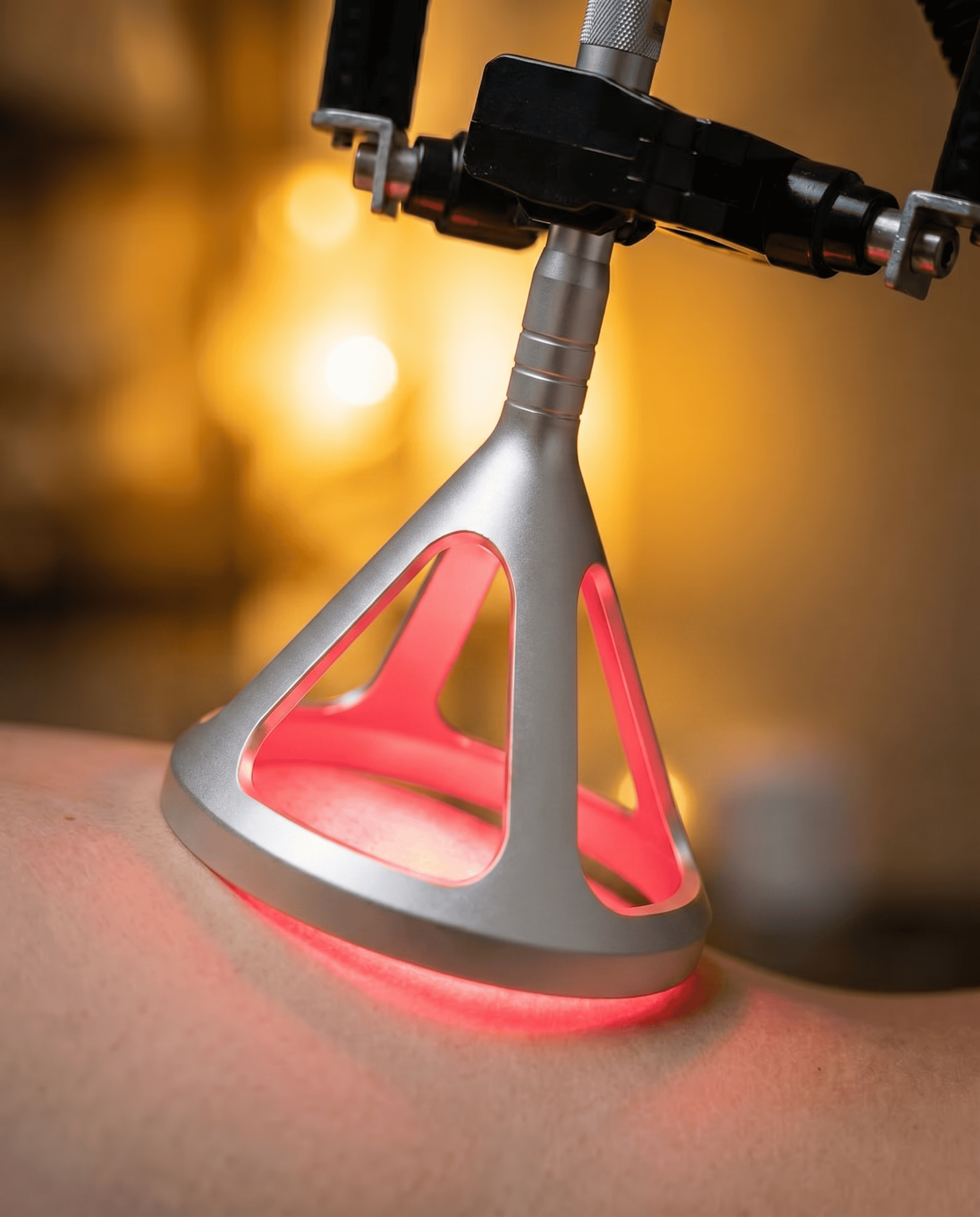
You will feel heat. Real heat — not just gentle warmth. Most of the time it’s comfortable, even pleasant. But the laser is powerful enough that under certain conditions it can get too hot. The most common situation where that happens is over tattoos. The dark ink absorbs the laser energy much more aggressively than untattooed skin, and that area heats up faster.
We watch for this. If we’re treating a region with tattoos, we lower the intensity over that area and keep the handpiece moving. Tell your doctor or therapist if it ever feels too hot — we’ll dial it down.
Sessions run 5 to 15 minutes depending on what we’re treating and how big the area is.
Eye Safety — We Wear the Glasses Every Time
Class IV lasers can damage your eyes if the beam hits them directly. Both you and your provider will wear protective laser eyewear during every session — no exceptions. Anyone else in the room when the laser is on also wears glasses. This isn’t optional and it isn’t a formality. The wattage that lets the laser reach deep tissue is the same wattage that can injure unprotected eyes.
Class III vs. Class IV — Why Power Matters
You’ll see “cold laser,” “low-level laser,” “Class III,” and “Class IV” used in different clinics. Here’s the difference, in plain terms.
The international laser classification standard draws the line at 0.5 watts. Anything at or below 0.5W is Class IIIb. Anything above is Class IV.
Our MedRay Quad 27.7W laser puts out 27.7 watts — that’s over 55 times stronger than the Class III/IV threshold.
Why does that matter? Dose. Photobiomodulation works at a specific energy density (measured in joules per square centimeter). To reach that therapeutic dose with a cold laser, you’d need very long session times — often longer than is practical. A Class IV laser delivers the same dose in a fraction of the time, OR delivers a higher dose if the tissue depth and severity call for it. Deep structures — spinal discs, sciatic nerve, large joints, the lumbar erector muscles — simply don’t get there with a cold laser.
This is why the research consistently shows Class IV outperforms Class III for deeper musculoskeletal conditions. A 2020 randomized controlled trial published in Evidence-Based Complementary and Alternative Medicine (Abdelbasset et al.) compared high-intensity laser to low-level laser in patients with chronic low back pain — the high-intensity group had significantly better outcomes in pain, function, and lumbar range of motion.
What We Actually Use Laser For at McAlpine
Let me tell you what we see work in our clinic instead of recite a marketing list of every condition a laser company has ever published a brochure about. Here’s our honest experience.
What it works best for in our practice — acute musculoskeletal injuries:
- Acute spinal injuries — disc flare-ups, lumbar strains, acute facet irritation, post-adjustment muscle soreness. This is probably our most common use.
- Sports injuries — sprains, strains, contusions, acute tendon irritation. The faster we can get the tissue metabolism moving, the faster the athlete is back.
Other applications where we see good results:
- Diabetic neuropathy — the laser improves circulation and stimulates nerve repair in the affected tissue. A 2024 systematic review in BMC Neurology analyzed 95 studies and found photobiomodulation produced better outcomes when combined with standard care for diabetic peripheral neuropathy.
- Tendonitis / tendinopathy — lateral epicondylitis (tennis elbow), rotator cuff tendinopathy, Achilles tendinopathy, infrapatellar tendonitis. Multiple randomized trials in Lasers in Medical Science (Dundar 2015, Stiglic-Rogoznica 2011) have shown high-intensity laser is effective for these.
- Post-herpetic neuralgia — the nerve pain that lingers after a shingles outbreak. Standard medical care can be hit-or-miss. We’ve had good results when we dial the laser in with settings tailored for nerve pain — different parameters than what we’d use for a muscle strain.
- Nerve palsy — particularly when there’s a clear mechanical or inflammatory cause and the nerve is salvageable. One case we treated took several months, but the patient’s grip strength and range of motion came all the way back — matching their healthy hand by the end.
Where we don’t see great results in our practice — the honest truth:
- Degenerative knee pain (osteoarthritis) — published research shows promise, but in our patient base, results are inconsistent. Sometimes meaningful, often modest. These days, we mostly use laser on knees in two situations: post-surgical recovery, or alongside active PT rehab where it complements what they’re already doing.
- Plantar fasciitis — same story. The research is mixed, and our clinical experience tracks with the modest end of those studies. We’ll try it if you want, but I won’t oversell it.
If we don’t think the laser is the right tool for your specific condition, we’ll tell you. We’d rather under-promise and get you to the right treatment.
What a Session Costs
- Single session: $40
- Package of 6: discounted (about a 10% savings per session)
- Package of 12: discounted further (best per-session value)
The reason packages make sense: laser therapy is cumulative. The effect of one session is real, but the meaningful tissue-level changes happen across a course of treatments. Acute injuries often respond in 4–6 sessions. Chronic or nerve-related conditions usually need 8–12. Your doctor will outline what we expect at your initial visit.
How Laser Fits With the Rest of Your Care
Laser therapy is rarely the whole answer — it’s one tool. For most patients we combine it with:
- Chiropractic adjustments to address the underlying joint dysfunction
- Spinal decompression for disc-related back and leg pain
- Massage therapy to release the soft-tissue tension contributing to the problem
- Targeted exercise prescription — our doctors have passed the national board exam for physical therapy and prescribe corrective work in-office; we coordinate with local PTs when rehabilitation needs go beyond what we do in-house
The adjustment opens the door. The laser speeds your body’s response through it.
FDA-Cleared. Drug-Free. Non-Invasive.
The MedRay Quad 27.7W is FDA-cleared for pain relief, improved circulation, and tissue stimulation. There’s no medication, no injection, no incision, and no downtime. You walk in, get treated, and go back to your day.
Frequently Asked Questions
Does laser therapy hurt?
No. You’ll feel heat, which is usually comfortable. If anything ever feels too hot, tell your provider and we’ll lower the intensity. We pay extra attention over tattoos because the dark ink absorbs more energy.
How quickly will I notice results?
Many patients feel less pain and more mobility after the first session. The bigger tissue-level improvements build over a course of 6–12 sessions.
Is Class IV laser safe?
Yes, when used by a trained provider. Eye protection is mandatory for everyone in the room. We avoid treating directly over active cancer, over the pregnant uterus, and over open wounds without a clear reason. Your doctor will review all precautions before starting.
How many sessions will I need?
Acute injuries: 4–6 sessions. Chronic or nerve conditions: 8–12. Your doctor will give you a specific plan after evaluating you.
Does insurance cover laser therapy?
Coverage varies. Our front-desk team can verify your benefits before you start. Many patients find the cost reasonable given how quickly the treatment moves the needle on conditions that have been dragging on.
Will laser therapy replace surgery?
For many patients, yes — when combined with adjustments and decompression, conditions that patients have been told would need surgery often resolve conservatively. Some conditions truly do require surgical intervention, and we’ll be honest with you about which is which.
When Laser Is the Right Next Step
If you have an acute injury — a recent disc flare, a strained back from yard work, a tendon that’s been nagging for weeks — laser therapy is one of the fastest tools we have to move the healing along. If you have stubborn nerve pain from diabetes, shingles, or a nerve palsy, it’s worth trying. If you have chronic degenerative knee pain or plantar fasciitis, we’ll talk through your options honestly — laser might help some, and we’ll tell you our experience.
Schedule an evaluation:
- Call: 616-392-7031
- Book online: McAlpine Chiropractic — Schedule Now
- Visit: McAlpine Chiropractic, 500 West 17th Street, Holland, MI 49423
Phillip Maletta, DC