
A golf swing can put about eight times your body weight of compressive force on your lower spine — and you’re doing it 80, 90, maybe 100 times per round.
So when you wake up the morning after a round and can barely bend over to tie your shoes, it’s not just “getting older.” Something mechanical is happening with your spine, and it’s fixable.
Nearly 1 in 4 golfers deal with lower back pain after every round, according to data from the Titleist Performance Institute’s survey of over 31,000 golfers. If that sounds familiar, keep reading — because the solution probably isn’t what you think.
Your Lower Back Isn’t the Problem — It’s the Victim
Here’s the insight that changes everything: your lower back is rarely the cause of golf back pain. It’s the victim.
The golf swing demands rotation from your hips, mid-back (thoracic spine), and shoulders. When any of those areas are stiff, fixated or restricted (which they are if you’re one of us who sits at a desk all week) your lower back picks up the slack. It’s forced to rotate more than it’s designed to, absorbing forces it was never meant to handle. In our experience as a chiropractor in Holland, MI, this is one of the most common mechanisms for low back pain and injury.
The Titleist Performance Institute calls this the most common pattern they see in injured golfers. Your lumbar spine is built for stability, not rotation. When it’s asked to do both, something eventually gives.
That’s why stretching your lower back, stretching your shoulders, or popping ibuprofen before a round doesn’t solve the problem. You’re treating the symptom while the actual restriction — usually in the hips, sacro-iliac joints, or thoracic spine — stays locked up.
Why the Pain Shows Up the Morning After
This one confuses a lot of golfers. You feel fine during the round, maybe a little tight on the back nine, but nothing terrible. Then you wake up the next morning and your back is on fire and you feel like you aged 10 years overnight.
Here’s what’s happening: during your round, adrenaline and movement keep inflammation in check. But overnight, while you’re still, your low-back blood circulation decreases and the inflammatory response catches up. Muscles that were overworked tighten and guard. Irritated joints swell and bind up. By the morning, everything has stiffened around the insult your swing created.
This delayed-onset pattern is actually your body’s way of telling you the problem is structural, not just muscular. If it were a simple muscle strain, you’d feel it immediately. The fact that it peaks 12 to 24 hours later points to joint dysfunction and cumulative stress — exactly what chiropractic care is designed to address.
3 Ways to Fix Golfer’s Back Pain
1. Restore Hip and Thoracic Mobility
Since your lower back is compensating for restrictions elsewhere, the first fix is opening up the areas that should be doing the work.
Before every round, spend at least 10 minutes warming up — not just taking practice swings. Research published in the Asian Journal of Sports Medicine found that golfers who warmed up for more than 10 minutes had roughly half the injury rate of those who did shorter warm-ups or skipped it entirely.
Try these three moves:
- Hip 90/90 stretch — sit on the ground with both legs bent at 90 degrees, rotate side to side. Opens internal and external hip rotation.
- Thoracic spine rotation — on all fours, place one hand behind your head/neck and rotate that same elbow toward the ceiling. This unlocks mid-back rotation so your lumbar spine doesn’t have to compensate. Bonus: pause and take a deep breath at the top of the range of motion.
- Standing trunk rotations with a golf club — hold a club across the back of your shoulders and rotate slowly, feeling the movement come from your mid-back, not your lower back.
If your hips and mid-back are genuinely restricted — not just tight from sitting — a chiropractor can identify and correct the specific joint restrictions that stretching alone won’t fix. At McAlpine Chiropractic, we assess the full kinetic chain from ankles to shoulders (and more) so we know exactly where the compensation is coming from.
2. Get the Alignment Right
When spinal joints are misaligned or not moving properly, your body compensates in ways that multiply stress through the swing. A joint that’s stuck in your mid-back forces the segments above and below it to move more — and in golf, that extra movement happens under enormous load.
Chiropractic adjustments restore proper motion to restricted joints. For golfers, this typically means working on the thoracic spine, pelvis, and SI joints — the areas most commonly locked up from sitting and repetitive swing mechanics.
For golfers dealing with disc-related pain — herniated discs, bulging discs, or chronic compression — non-surgical spinal decompression gently creates negative pressure in the disc space. This allows bulging disc material to retract and promotes nutrient flow to damaged discs, supporting the healing process without surgery.
3. Speed Up Tissue Recovery
Even with great mobility and alignment, the repetitive nature of the golf swing creates microtrauma in muscles, ligaments, and joint capsules. Your body can heal this on its own, but it takes time — and most golfers don’t want to wait six weeks between rounds.
Class IV laser therapy accelerates the body’s natural healing process at the cellular level. It increases blood flow, reduces inflammation, and stimulates tissue repair in the muscles and joints that take the most punishment during your swing. Many of our patients notice reduced soreness and improved range of motion within a few sessions.
Combined with chiropractic adjustments, laser therapy helps your body recover faster between rounds so you’re not starting each game already behind.
One More Tip: Ditch the Carry Bag
You know the feeling. Somewhere around the 13th hole, the strap that felt fine on the first tee is digging into one shoulder. You’re hiking the bag back up every few holes, leaning a little to the other side to balance it, and a deep, dull ache has settled into one side of your low back.
Picture what that’s doing down at the disc level. The discs in your lower back are fluid-filled cushions — they squeeze down under load and draw fluid back in when the pressure comes off. Hang a bag on one shoulder for four hours and those discs stay pressed down and unevenly loaded the entire round, never getting a chance to recover. By the back nine they’re flatter, more irritated, and more sensitive — and that’s the exact moment you ask them to absorb another full-force swing.
That’s why the last few holes are so often where the real pain shows up — and why it’s waiting for you again the next morning.
Switching to a push cart is one of the simplest changes you can make. It won’t fix a mobility problem, but it takes that all-day, one-sided load off your spine so your discs aren’t already maxed out before you swing.
You Don’t Have to Quit Golf
This is the fear we hear most often: “If I tell my doctor about this, they’ll tell me to stop playing.”
That’s not how we work. At McAlpine Chiropractic, the goal is always to keep you doing what you love, as quickly as possible, with a body that can handle it. Golf isn’t bad for your back. A body that can’t handle the demands of golf is the problem, and that’s something we can work on together.
Drs. Ben De Young, Ann McAlpine, and Phillip Maletta treat golfers throughout the season here in Holland, MI. Whether you’re dealing with pain after every round or want to prevent it before it starts, we’ll build a plan around your game — not ask you to give it up.
Ready to fix your golfer’s back? Call us at 616-392-7031 or book online to schedule your evaluation.
Frequently Asked Questions About Golf Back Pain
Why does my lower back hurt after every round of golf?
Your lower back is likely compensating for restricted mobility in your hips and thoracic spine. The golf swing demands rotation from these areas, and when they’re stiff, your lumbar spine absorbs the extra load. Nearly 28% of golfers in a Titleist Performance Institute study reported recurring lower back pain — it’s the most common golf injury by far.
Is golf bad for my back — should I stop playing?
Golf doesn’t have to be bad for your back. The issue isn’t the sport itself — it’s playing with restricted joints, poor mobility, or unresolved injuries. With proper care and a good warm-up routine, most golfers can play pain-free. No healthcare provider worth their license wants you to stop being active.
Why does my back hurt the morning AFTER golf, not during the round?
During play, adrenaline and movement mask the inflammatory response. Overnight, your body’s healing process kicks in — irritated joints swell, overworked muscles tighten and guard, and inflammation peaks. That delayed-onset pattern actually tells us the problem is joint-related, not just a simple muscle strain.
Can I keep playing golf with a herniated or bulging disc?
Many golfers do, but it depends on the severity. Non-surgical spinal decompression can help relieve disc pressure and support healing, while chiropractic adjustments and laser therapy manage pain and restore function. The key is getting an accurate diagnosis so you know what you’re working with — not just pushing through and hoping for the best.
Should I see a chiropractor, PT, or orthopedic doctor for golf back pain?
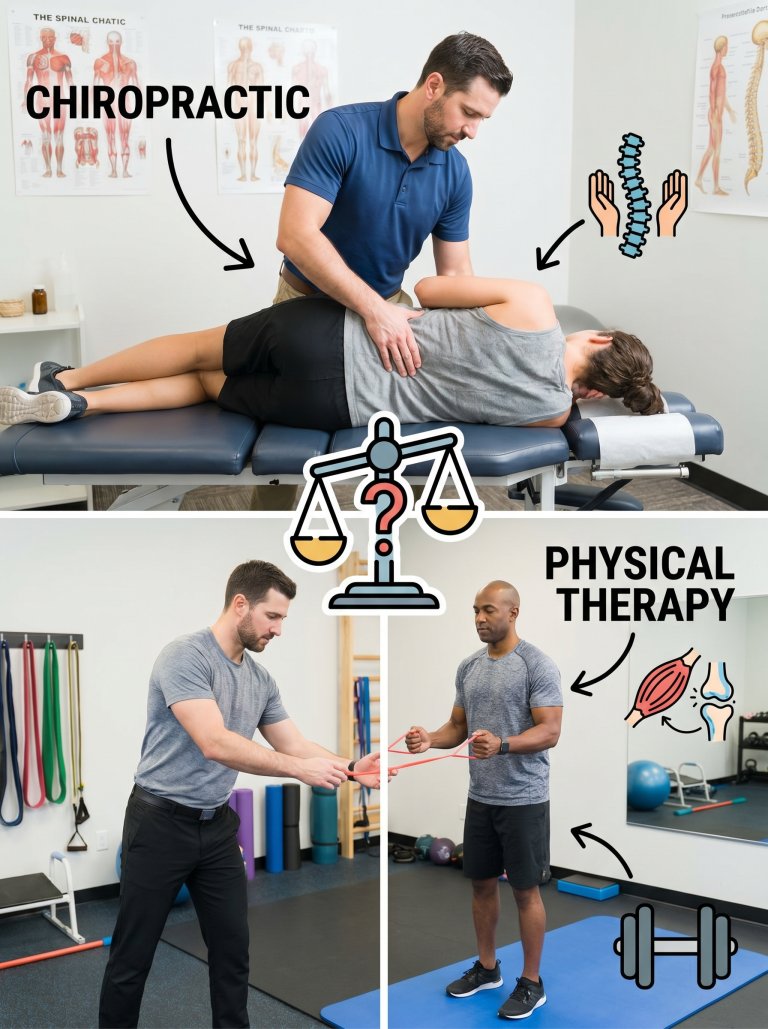
For most golf-related back pain, chiropractic care is a strong first step because the root cause is usually joint restriction and spinal mechanics — exactly what chiropractors specialize in. If you need strengthening and rehab exercises beyond what we provide in-house, we’ll refer you to a physical therapist we trust. And if imaging reveals something surgical, we’ll connect you with the right specialist. The approaches are complementary, not competing.
How much force does a golf swing put on my spine?
Biomechanics research (Hosea & Gatt) estimates that the golf swing generates compressive loads on the lumbar spine of roughly eight times your body weight — peak loads measured around 6,100 N (about 1,370 lbs) in amateur golfers and 7,584 N (about 1,700 lbs) in professionals. That’s a heavy, repetitive load, which is why mobility, swing mechanics, and recovery matter so much for protecting your back over a full round.
What’s the best warm-up to prevent golf back pain?
Spend at least 10 minutes warming up before your round. Focus on hip rotation (90/90 stretch), thoracic spine mobility (rotation drills), and gentle trunk rotations. Research shows that golfers who warm up for more than 10 minutes have roughly half the injury rate of those who skip it or rush through it.
When should I worry about golf back pain?
Seek immediate medical attention if you experience leg weakness, numbness or tingling that runs down your leg, or any changes in bowel or bladder function alongside back pain. These symptoms could indicate nerve compression that requires urgent evaluation. For persistent pain that doesn’t improve with rest and stretching, schedule an evaluation sooner rather than later — early intervention prevents small problems from becoming big ones.
At McAlpine Chiropractic, we help golfers across Holland, Zeeland, and West Michigan get back on the course without pain. Our office is located at 500 West 17th Street, Holland, MI 49423.
Sources:
– Titleist Performance Institute, “The Golfer’s Guide to Lower Back Pain” (n=31,000 golfers)
– Lindsay D, Horton J. “Comparison of spine motion in elite golfers with and without low back pain.” Journal of Sports Sciences. 2002.
– Hosea TM, Gatt CJ Jr. “Back pain in golf.” Clinics in Sports Medicine. 1996 — lumbar compressive loads during the golf swing (~6,100 N amateur, ~7,584 N professional).
– PMC, “Golf-Related Low Back Pain: A Review of Causative Factors and Prevention Strategies.” Asian Journal of Sports Medicine. 2015.
– PMC, “Risk Factors for Low Back Pain in Golfers: A Systematic Review and Meta-analysis.” 2018.